

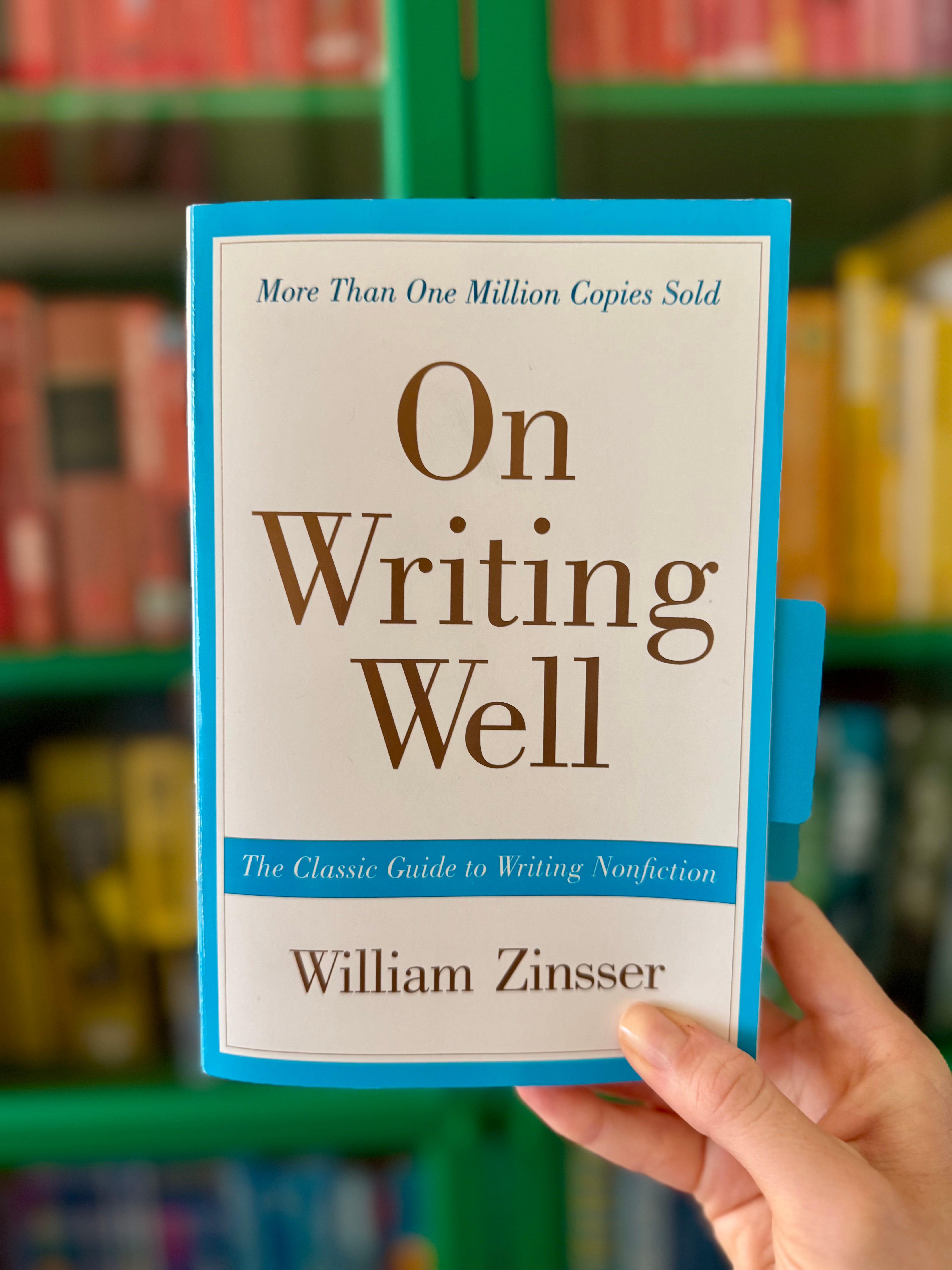
On every serious nonfiction writer’s shelf you will find a battered copy of On Writing Well, William Zinsser’s honest, foundational guide to good nonfiction writing. Today I argue that this book should also appear on the shelves of marketers, journalists, and climate communicators.
This is not a book to run through some AI book summary program to get the highlights. It is worth reading in full, and then re-reading, and then, another year or so later, reading again.
But while I encourage you to read the whole book, I will spoil some of it for you now by diving into my most powerful takeaway of the book, which is Zinsser’s four Articles of Faith for good writing: clarity, brevity, simplicity, and humanity.
Let’s take a look at how each of these apply to good climate writing.
1 — Clarity
“A clear sentence is no accident,” says Zinsser, and yet, I have to believe that, in the corporate world, an unclear sentence is also typically no accident. Maybe it is — maybe some marketers like the aspirational sound of certain claims and don’t dwell enough on what they actually mean.
But many companies obscure deliberately, particularly in their climate communications. They force their audience to project their own ideas into the gaps between the meaningless words. To a favourably predisposed audience, this may be a winning strategy. “Committed to carbon neutrality” or “eco-friendly” might sound good to a ten-year-old (actually, they’ll probably question you on it — what does that mean?). But in 2025, with most of us skeptical of anything and everything, obfuscation almost always backfires. Reading between the lines will lead to negative, not positive, conclusions. Far better to simply tell the truth.
2 — Simplicity
“Clutter is the disease of American writing,” says Zinsser. “We are a society strangling in unnecessary words, circular constructions, pompous frills and meaningless jargon.” Imagine if Zinsser read something written by ChatGPT.
If corporations tend to fear clarity, but it is often individual writers and professionals who fear simplicity. They don’t want to sound dumb, so they make sentences longer than they need to be and add vague buzzwords that they know will allow their work to ‘pass’ in a corporate setting.
Simplicity is a tricky line to walk in climate communications. Some climate messaging is too complex, that’s for sure: some experts take the IPCC report approach, drowning people in confusing scientific jargon and assuming too much existing knowledge from their audience. But most of the time, and particularly in the corporate and marketing realms, oversimplification is what misleads consumers and leads to greenwashing allegations (and lawsuits). This style of communication takes advantage of its audience’s lack of knowledge, hoping to dazzle by making ideas seem accessible when they are really just misrepresented.
The classic “we planted X trees” and “made from recycled materials” claims are so simple that even a child could seemingly grasp the idea. But planted trees means little on its own: What kind of trees? Where? How are they maintained? What are they intended to compensate for? Same goes for claims about recycled materials, but I feel tired just thinking about the complexity.
Suffice it to say that claims like “planting trees” and “recycled” follow the principles of good writing in that they use visible, tangible nouns and verbs (the alternatives might be “offsets” and “non-virgin,” for example). They might be perfectly appropriate as headlines. But without additional explanation and context, these types of claims almost always take advantage of the simplicity principle to mislead.
3 — Brevity
Interesting that brevity is the third article of faith and not the first. If you listened to most Internet writing wisdom, you’d think that shorter is always better and the only thing wrong with your writing is its length. In a publishing environment defined by character limits, maybe this is true. But Zinsser put brevity third for a reason. Clarity is the only true objective of writing: to accurately communicate an idea. Everything else is in service of clarity, including length. The right length is whatever delivers the clearest message.
Climate communicators who believe “shorter is better” run the risk of prioritising brevity over clarity. By way of example, last year, Meg and I analyzed the sustainability reports of the 100 largest companies in the world and noticed something interesting. Many companies broke from their years-long trend of publishing 100+ page sustainability reports and instead released simple fact sheets, often only a dozen pages long, mostly filled by sparse data tables and very little surrounding narrative.
At first we wondered if this was a win. Moving to quantifiable progress reporting surely means fewer avenues for greenwashing. But we soon realised that many of the data reported were almost meaningless without appropriate context and narrative. What looked like progress was really just cowardice. Companies were so worried about being accused of greenwashing that they mistook length and format for dishonesty. This is a false assumption. Sometimes telling the truth can take a little longer, because the truth, as we know, is rarely simple and never pure.
“Nowhere else must you work so hard to write sentences that form a linear sequence. This is no place for fanciful leaps or implied truths. Fact and deduction are the ruling family.”
— William Zinsser, on the challenges of science writing
4 — Humanity
If I were redesigning the articles of faith (and I would never!), I’d probably put humanity second. Especially in the age of AI and meaningless online content designed simply to boost page rankings. The only reason writing matters is if it is made by, and consumed by, humans. Nothing else is worth doing.
“Writing is an intimate transaction between two people,” says Zinsser, “and it will go well to the extent that it retains its humanity.” We can blame marketing for making soulless corporations seem too human, like feel-good ads from fossil fuel companies or inspirational life vignettes from a company that makes billions selling brown sugar water. The cliched branding advice is to anthropomorphize your company — to give your brand an identity so that buyers feel loyal to it. I think this is a bastardisation of the kind of ‘humanity’ Zinsser is talking about.
A truly human ‘brand’ or communications effort would lead with honesty on climate: putting their actions in context, admitting what they don’t yet know. It would not hide behind a logo or corporate legal team; instead, it would show the real people working on these issues, explain the challenges they face, and share every detail it could in the hope that others will learn too.
“A generation ago our leaders told us where they stood and what they believed,” says Zinsser. “Today they perform strenuous verbal feats to escape that fate.” Americans, Zinsser believes, are no longer willing to go out on a limb.
Certainly this is true of today’s corporations and business leaders, who will happily release a bland statement about the importance of diversity, or climate action, or whatever the issue du jour is, while doing precisely nothing about it and pulling out of commitments when the going gets tough
Most corporate climate commitments are simply watered down versions of what a handful of pioneers are doing. Most companies hide the fact that they don’t have all the answers yet, that they haven’t figured out exactly how this climate journey is going to play out. And most will sidestep the obvious questions when progress gets derailed, or, as we’ve seen in the last 18 months, simply drop their commitments altogether. (Another reason why ‘commitment’ is a weasel word.)
In the non-corporate world, humanity has to be the #1 most important element in all communications about climate change and climate solutions. Most of us care about humans — ourselves especially — far more than we care about forests or polar bears or coral reefs. Climate change has uniquely human consequences and solutions, and the environmental movement’s frequent failure to acknowledge that has cost it significantly.
Conclusion
I keep coming back to Zinsser’s four articles of faith because I think they are all a writer needs: I would add nothing and remove nothing. The four articles are the essence of good writing, speaking, communicating. And they matter more than ever in the age of AI.
What we’re curious about this week
📚 Book: Enshittification, by Cory Doctorow
I heard Doctorow on a podcast recently and knew I had to read his book, which explains so much of why our online and offline worlds seem to be feeling shittier and shittier. Doctorow is a highly engaging writer and also possibly the best audiobook narrator I have ever listened to.
📺 TV Show: The Diplomat (Netflix)
Wow, a new format! Instead of a podcast, here’s me telling you to go and binge-watch The Diplomat if you haven’t yet. I think it’s my favourite Netflix show, maybe ever? (Though that wouldn’t be hard.) Keri Russell is phenomenal, and if you’re a Sorkin fan, like me, a few West Wing favourites show their faces…

Ways we can help 🫶
🎯 Need help building an organic lead-generating machine? → See our lead gen services
📥 Want to know what’s trending in the world of sustainability reporting? → Download our free PDF: 2025 State of Sustainability Reporting
📣 Share this with your climate tech marketing team