

I am starting to question the use of the term ‘voluntary’ in sustainability settings.
Volunteer comes from the Latin word voluntas, meaning ‘will’ in the sense of ‘free will’ or ‘choice’. In the technical sense, then, it is accurate for corporate sustainability measures taken outside of legal requirements.
However, in the popular imagination, volunteering evokes images of well-meaning people ladling out minestrone in disposable bowls, or handing out blankets on cold winter nights, or shampooing abandoned dogs at the animal shelter. People who go out of their way to make a difference to people or creatures they don’t know and aren’t responsible for.
But when a company takes ‘voluntary’ sustainability action, this is hardly the equivalent of it spending its Saturdays at a soup kitchen. Rather, it is simply taking the bare minimum effort to compensate for destructive business models.
Perhaps an analogy will help.
When will companies start picking up after themselves?

A company that sets a ‘voluntary’ target to reduce greenhouse gas emissions is a bit like a dog owner that claims to be ‘voluntarily’ picking up only a fraction of the 💩 its dog leaves on the sidewalk. Actually, this is hardly equivalent: here in Queensland, Australia, a dog owner can be fined $333 for failing to pick up after their dog. We can be fined $83 for simply not carrying poo bags with us. All this for a substance that might cause a person some frustration if they step in it, but actually is quite good for the soil when you think about it.
How much do Australian companies pay for spewing carbon dioxide into the atmosphere? Something that does not in fact enrich the atmosphere (as poop might to do soil), and is far more destructive to the entire planet than a little bit of poo on shoe (although that is disgusting).
Queensland’s hyper-obsessive dog laws might be ruining that analogy a little, because technically, dog owners do have to pick up after their dogs, while companies, for the most part, do not have to clean up their carbon.
Yet at the same time, you don’t see dog owners loudly proclaiming in the streets about how committed they are to picking up 20% of their dog’s poo, taking photos of themselves plopping it in council bins, and being featured in magazines for their good work. Dog owners (not all) accept the responsibility that comes with caring for an animal that sometimes leaves unpleasantness in its wake. If only the same could be said of corporations.
When will companies take care of the people in their charge?
Let’s try another analogy — let’s look at human rights. When a company with known human rights abuses in its supply chain commits to “fully auditing its value chain,” it is hardly going above and beyond. Rather, a company that vaguely commits to sussing out the things it knew about all along is like a parent that finally relents to taking their child to the doctor for a broken arm a week after the injury.
Regardless of what the law says, we expect parents to take full and immediate responsibility for their children. Having children, in most developed countries, is a voluntary exercise — much like starting a business. And yet once again the analogy falters here, because child abuse and neglect is a criminal offence (as it should be, don’t misread me); and yet abuse or neglect of other people’s children, so long as they are simply picking cocoa beans or sifting for cobalt in the 79th tier of your supply chain, is something a company can claim credit for fixing rather than eternal shame for allowing. Neglectful parents go to prison; neglectful companies are bailed out and rebranded.
A society that mandates individual responsibility and excuses corporate irresponsibility
My analogies have failed here in part because we exist in a world that punishes individuals and praises entities. We tax personal income and let companies operate from offshore accounts, we fine drivers for not wearing seatbelts (too dangerous) and subsidise fossil fuel companies. We let companies destroy ecosystems and atmospheres, dehumanise workers, abuse children — and then celebrate them in business magazines when they commit to the absolute bare minimum of compensation for their wrongdoing.
We celebrate the arrival of LED lightbulbs in factories where carcinogenic products are unapologetically made; the electrification of fleet vehicles driven by Amazon workers who must pee in bottles to hit their quotas and have their eye movements tracked by cameras; the planting of trees by a company outsourcing the screening of vile video content to despairing African workers.
There should be no real glory in voluntary sustainability action; only a deep sorrow for the way things have been done to date, an apology, and a heads-down approach to cleaning up the mess. Going into business is the real voluntary action — doing it responsibly should be implied.
New terminology for a new era of sustainability
Do we need a new word to replace the notion of ‘voluntary’ action? Perhaps duty? Responsibility? Answerability? Something that evokes the idea of being less bad, rather than all-good.
I do not wish to discourage companies from talking about the sustainability action they are taking, but we need a tone shift. There needs to be less self-congratulation and more serious and humble reckoning of just how bad we let things get before we started to pay attention and clean up after ourselves. Patagonia’s recent sustainability report might be the perfect example to follow.
I think sustainability teams get this. They understand that even ‘net zero’ or other laudable targets are hardly net positive outcomes for the world; simply less bad ones than have been acceptable previously. It is the business leaders and marketing teams that could most do with an understanding of just how ‘too late’ and ‘too little’ their voluntary action really is.
I’d love to see less hype and more hustle in the world of corporate sustainability.
There is still so much to be done.
What we’re curious about this week
📚 Book: On Freedom, by Timothy Snyder
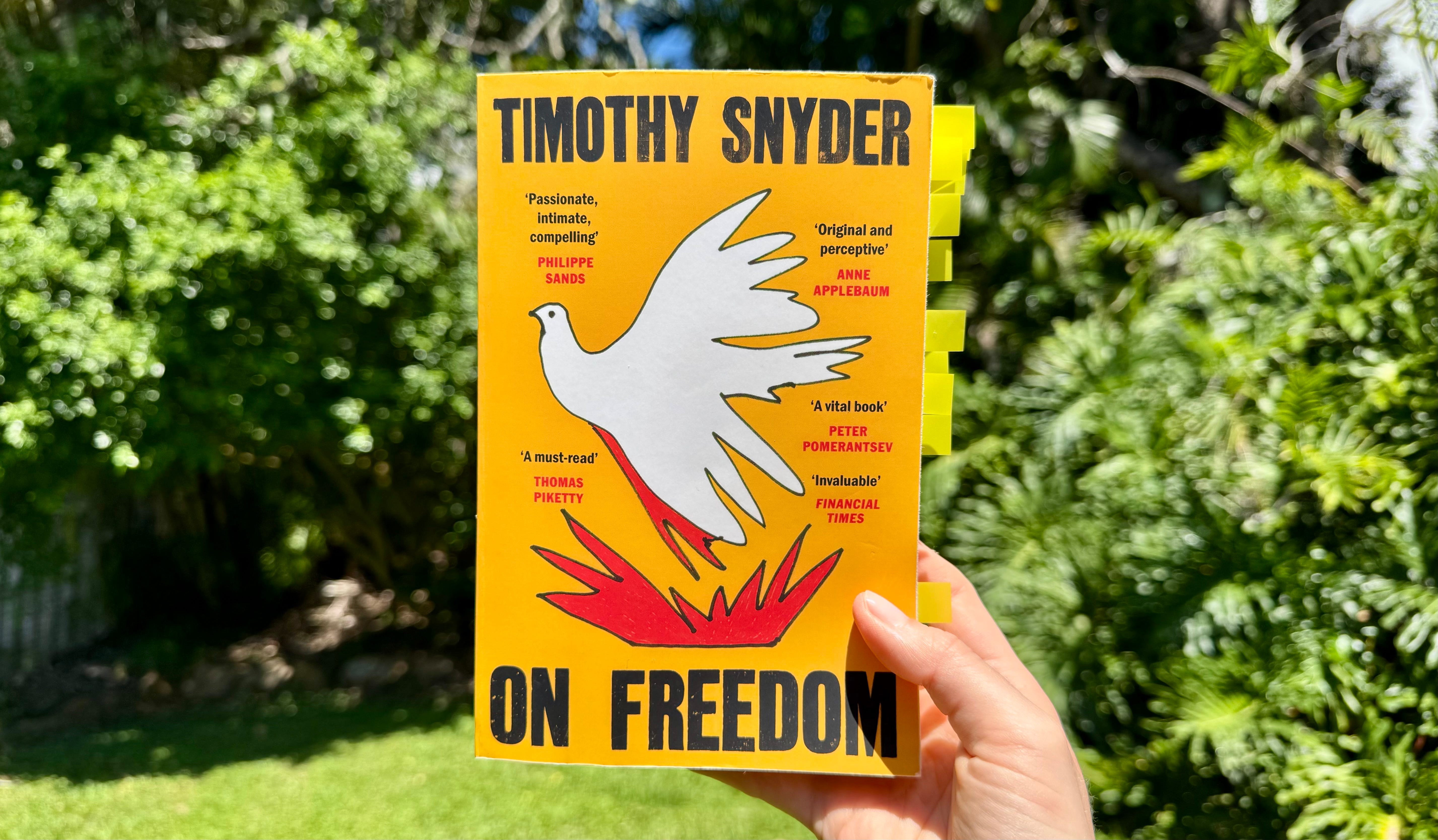
I picked up this book expecting a history lesson, but it gave me so much more than that. Snyder’s central premise is that our current notion of ‘freedom’ in most of the Western world (which has largely been claimed by the political Right) is one of ‘negative freedom’, or ‘freedom from’ — specifically, freedom from a powerful, interfering government. Many other non-right-wing movements in history have defined freedom in a negative sense, but our modern definition of freedom has been largely defined by the rise of neoliberalism (”the government is the problem”), the unquestioning quest for free markets, and the mostly false idea that unregulated capitalism is the best path to prosperity for all.
Instead Snyder advocates for and eloquently defines ‘positive freedom’ — one that begins with birth and lasts a long and fulfilling lifetime. Achieving positive freedom for a nation or the world requires not no government, but an able one: a government, society, and economy that supports the raising of babies, the education of children, the enabling of adults to live a life of their own choosing — not one predetermined by circumstances or the delusions of ideological leaders.
‘Freedom from’ is an ill-considered individual concept, the idea that each of us would be perfectly fine if other people (and people in charge) would just leave us alone. Yet no human being can achieve a good life alone. Without the love and support of other people, they wouldn’t make it past their first day on earth. In Snyder’s own (paraphrased) words on a CBC Ideas podcast, “If a book about freedom doesn’t mention childbirth, you don’t have to read it.” (As he notes, this rules out most of them.)
The history of negative freedom is long and dark. In the US alone, its origins are telling. “If your only obstacle in life is the government,” says Snyder, “then what does that say about you?” Those who fear government interference are those with something — slaves, property, profits — to lose. Meanwhile, those who need government support most (at the time, people of colour, women, children) were themselves desperately unfree, doing the active work required to make the people at the top ‘free’.
Positive freedom entails not removing but building. Building infrastructure, medical systems, welfare programs and other necessary safety nets that allow people to stop worrying about the basics of survival and instead live long and fulfilling lives. In some ways this ‘build’ philosophy has echoed other great books I’ve read this year around supply-side progressivism, including Abundance and Breakneck. But this book is more than political; it is deeply personal, chronicles fascinating moments in Snyder’s own, journeyed life, and reads in a meandering and philosophical way that demands full attention and slow reading.
This is not the kind of book you leave to AI summaries (most books are not, but this one especially). It is tender and compelling in all the ways that the current conversation around government efficiency and shutdowns and premiums and policy are not. This is a book that puts humanity back into the conversation around government, economics, and society.
This may be the best book I’ve read all year.
Ways we can help 🫶
🎯 Need help building an organic lead-generating machine? → See our lead gen services
📥 Want to know what’s trending in the world of sustainability reporting? → Download our free PDF: 2025 State of Sustainability Reporting
📣 Share this with your climate tech marketing team
It's so helpful when "sustainability" is broken down more tangibly
Love them