

Hi folks,
Amelia here, writing on a sunny Australian winter’s day. It’s the end of a productive week, the world is still turning, and I’ve got a stack of books to accompany me into the weekend.
Before I sign off for the week, let’s take a quick look at what’s happening in the world of climate comms.
This week’s briefing
❌ What’s bad
Greenwashing… or reef-washing?
Here in Australia, coral reefs are a kind of biological and cultural icon. We’re so proud of the Great Barrier Reef. We’ve also been happy to dredge it up to let coal and oil ships through it, and content to watch it bleach in rapidly warming ocean waters. But seriously, we love it.
So we get riled up when sunscreen companies (Banana Boat and Hawaiian Tropic) whack a misleading “reef-friendly” label on more than 90 of their sunscreen products.
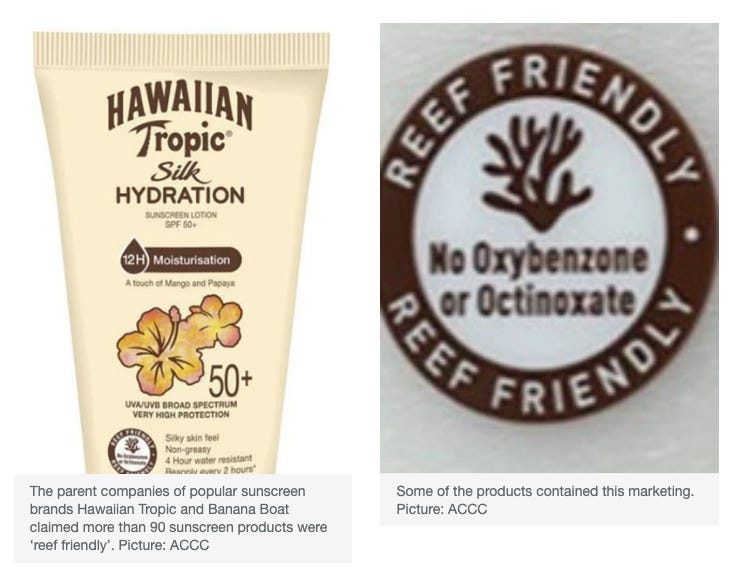
Here’s the logic behind this made-up label: These products didn’t contain some of the worst-known reef-harming chemicals (like oxybenzone). But they still included other ingredients, like octocrylene and homosalate, which scientific studies have also flagged as harmful to coral reefs.
So they made up a label, awarded it to themselves, and figured no one would notice. But even if they’d been totally right about being reef-friendly, this label should’ve raised red flags internally. It’s vague. It’s a brand-new concept for most consumers. And it’s technically complex — far too complex to be summed up in two words like “reef-friendly.”
Anyway, they’re paying the price now — the ACCC has launched legal action against the parent company.
But you don’t have to be a sunscreen company to use this farcical case study as a great example of what not to do in your climate comms.
Want to stand out? Great. Differentiation is good marketing (purple cows and all that). But making up your own label — one with no clear definition, no verification, and no third-party backing — isn’t standing out. It’s just greenwashing. Especially when you’re capitalizing on something as emotionally loaded as coral reefs.
✅ What’s good
Pope Leo interrupts vacation to talk about climate change
Climate change often feels like a battleground of political ideologies, but Pope Leo’s latest move is pretty cool. The new Pope interrupted his vacation to lead a special Mass — The Mass for the Care of Creation.
“We live in a world that is burning,” he says, encouraging Catholics to care for God’s creation. This is the second time in a week the Vatican has spoken out on climate change, and it’s more than just lip service.
The leader of the Catholic church is an ideal messenger for the climate cause. Religion has played both hero and villain when it comes to social progress — often driving community action at the local level, while also holding back broader movements for change. Today, the Catholic Church is often associated with conservative ideology, and because climate change has been politicized, that means many Catholics are now skeptical of climate action.
We could parade as many young, liberal science types as we like in front of Catholic audiences, telling them climate change is urgent and real — but more often than not, that just deepens the divide. What we need are messengers on the inside of those “out-groups”: people who speak from within their own communities, who use familiar language, and who remind people of shared values.
Katharine Hayhoe, an evangelical Christian and climate scientist, is another great example of an in-group messenger. That’s two so far. We need so many more.
What we’re curious about this week
📚 Book: The Anxious Generation — I tend to be late to the party on bestsellers and early to the party on extremely niche books that no one else will ever read (or hear about). This one is a bestseller you’ve all probably heard about, and — well — sometimes books do well for a reason. Anyone with a child or a future with children must read this book. Predictably, the backlash on Haidt’s work has begun, but something Ezra Klein said in his interview with Haidt now sticks with me (I’m paraphrasing): You could show me all the evidence in the world that says screens aren’t bad for kids, and I still wouldn’t let my kids sit on iPads all day. I just don’t think it’s a good way to be a human.
🎙️ Podcast: Margaret Atwood on American Myths and Authoritarianism — surprise surprise, another Ezra recommendation. This interview with Margaret Atwood was re-released a couple months ago, but recorded a couple years ago. If anything, it’s even more relevant today, which brings us to Ezra’s central point: Atwood sees everything. She is like the soccer player who sees where the ball is headed and gets there first. Only she’s playing a wholly different game.
🎙️ Another podcast: Mamdani, Trump, and the End of the Old Politics — New York has a new mayor and it’s basically because of TikTok. As far as politics goes, the new media game has officially replaced the old. As far as mainstream climate messaging goes — well — it’s time governments and NGOs took note. Both Ezra and Chris Hayes (The Sirens’ Call) shine in this episode. It’s a fun one.
What we’re working on
👉 SEO & AI for climate tech — I’m writing a guide on how to shift your content strategy to deal with the challenges of AI. It’s something every single one of our clients is dealing with. As I pull it together, I’d love to hear from you: what’s your traffic looking like lately? How much do you know about how AI is affecting it, and what are you doing to address it? (Hit reply and let me know.)
Ways we can help 🫶
🎯 Need help building an organic lead-generating machine? → See our lead gen services
📥 Want to know what’s trending in the world of sustainability reporting? → Download our free PDF: 2025 State of Sustainability Reporting
📣 Share this with your climate tech marketing team