
Watch your mouth: Why words matter for climate change
My response to New Scientist's special edition, 'How to think about climate change'

I spend a lot of time in the world of B2B sustainability talk. Inside that bubble (the one where corporate strategies, carbon market updates, and technical debates dominate), the conversation about climate change feels very different from its mainstream counterpart.
That’s why I always pay attention when I stumble across climate content aimed at a broader audience. The other day, wandering through a newsagency in the throes of a small existential crisis, I picked up something that fit the bill.
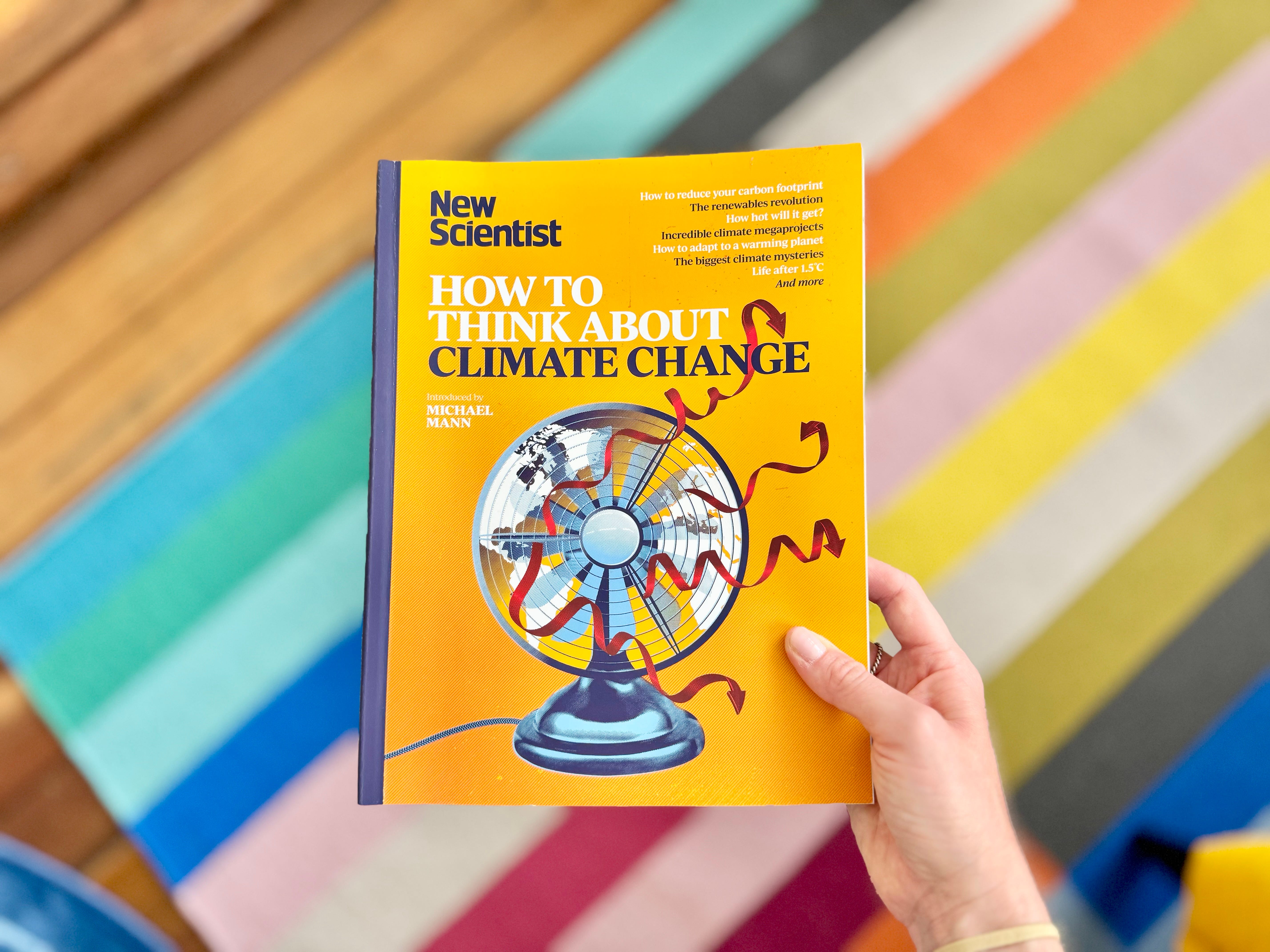
I paid $20 for this New Scientist special edition on How to think about climate change. That felt steep for a magazine, and it made me wonder: who else, besides someone who can expense this for work, is actually buying it? But that’s a topic for another day.
To save you the $20 (and information you already know, if you’re the kind of person to subscribe to this newsletter), here’s my review.
The positives
First, I was glad to see climate change get the broad coverage it deserves. At 96 pages, this edition offered enough space to give readers a real grounding. The scope was wide-ranging: starting with greenhouse gas emissions, then moving through warming impacts, renewables, technological innovation, adaptation, and future modeling. Within each area, it covered a lot of ground.
It provided a solid snapshot of where we are — progress to date, the challenges still ahead, and the debates over the best path forward even when everyone’s aiming at the same outcome.
The language and writing, despite being overly inflammatory (I’ll get to that below), was also strong. It was clear, accessible, and painted vivid pictures — good science communication principles in action. Here are a few examples:
Researchers fear that if biomass particles can’t sink as deeply into the ocean depths, the carbon they contain won’t be locked away for as long.
***
From dust and the soot emitted by power plants to floating fungi, aerosols serve as seeds on which water droplets or ice crystals can form and create a cloud.
***
Hydropower reservoirs are giant reserves that store rain and meltwater, ready to be released through energy-generating turbines when demand peaks.
***
At the moment, half the CO₂ we emit is soaked up by the land and seas, for instance as vegetation grows. As the planet gets warmer, plants on land aren’t going to take up ever more CO₂…. CO₂ is less soluble in warm water, so warming oceans may soak up less of it too.
The not-so-positives
World on fire, or language on fire?
Maybe it’s because I spend every day in this space, but the rhetoric around climate change often feels overbearing. The reliance on inflammatory language has become so predictable in climate communications that it risks becoming a cliché.
Strong words have their place. We have terms like genocide, autocracy, and crisis for a reason. And I support deliberate choices, like The Guardian’s shift from “global warming” to “global heating” or from “climate change” to “climate crisis.” Those changes sharpen meaning.
But what we see too often is not careful word choice but worn-out cliches. These phrases create stress without giving any real clarity. They make the already-convinced feel more anxious, but they give the skeptics another reason to roll their eyes.
I wrote about weasel words a while back — the vague aspirational corporate buzzwords companies use when trying to obscure a lack of action or progress. What I’m talking about here is something different. It’s language that feels more along the lines of the boy who cried wolf — constant alarmism, even when it’s falling on deaf ears.
The words that appeared over and over in this magazine are not weasel words, but maybe we can call them something else: wolf words. Words that make us feel anxious but also hopeless. This kind of language cries urgency so often, and so predictably, that eventually it stops landing.
Here are a few examples from this edition:
filthy fossil fuels
slash our greenhouse gas emissions
pumping huge volumes of carbon dioxide… into the atmosphere
the world emits a whopping 50 billion tonnes…
extreme heatwaves ravage many parts of the world
we need to slam on the brakes as hard as we can
catastrophic and irreversible
on the brink of catastrophe
breaching disastrous “tipping points”
the stark reality of the sweltering future
soaring temperatures
devastating bushfires
fierce heatwaves, sharp declines in polar ice, deadly flooding and uncontrollable wildfires…
deadly heat
dire consequences
increasingly hellish
Worth taking a moment to check your heart rate after reading this list. How do you feel?
I’m not saying these words should never be used. But they land harder when used sparingly, and it’s important to notice what it feels like to read sentence after sentence of them.
In a fun little twist, the magazine devotes a whole page to why doom-and-gloom messaging backfires. 10/10 for irony.
What is “too late?”
“Too late” is a phrase I see all the time in climate communications, and the more you understand climate science, the less sense it makes. This edition of New Scientist leaned on it heavily.
We should be cautious with this wording for two reasons. First, it’s vague. Unclear writing is bad writing. If you use a phrase like “too late,” you have to define what it means: too late for what, exactly? Too late to limit warming to 1.5°C? Too late to avoid specific impacts? Without definition, it’s just noise.
Second, it turns a complex continuum into a false binary. Climate change doesn’t flip from “safe” to “doomed” at some arbitrary threshold. Every action and every fraction of a degree matters. Framing it as a point of no return risks encouraging despair and disengagement rather than urgency.
I understand why communicators reach for it. It signals urgency. It simplifies. But climate change is one of those topics where simplification has limits. As the Einstein line goes: things should be made as simple as possible, but no simpler. Climate change is a spectrum, and the public needs to understand that every bit of progress counts.
To its credit, the edition did acknowledge this nuance at one point—but that recognition sat uneasily alongside the “too late” framing used elsewhere.
By the way, it’s all your fault
My first red flag was the cover, which listed ‘How to reduce your carbon footprint’ as the first topic of discussion within. I don’t think there’s anything wrong with addressing your own impact. Taking individual steps can make people feel powerful, in control, and aligned with their values. But these conversations should never happen without acknowledging where the true responsibility lies: the systems, policies, and industries that are really driving climate change. This gets a brief mention in the magazine, but in a different section.
Without that context, personal-carbon-footprint messaging often backfires. Most people won’t make all the recommended changes, and instead of feeling empowered, they’re left feeling guilty or ashamed. Shame is not a productive emotion — it entrenches paralysis.
Why so anxious?
To top it off, this edition ended with a piece on eco-anxiety, which felt particularly jarring after so much doom-laden language about tipping points, feedback loops, and irreversible damage. The advice was mostly about how you can manage your feelings — with no acknowledgment that media like this might be fuelling those feelings in the first place.
Even stranger, the article skipped over one of the most practical strategies: curating your information diet, especially social media, to avoid overwhelming narratives. Instead, it circled back to advice about shrinking your own carbon footprint, as if plugging in your Tesla will solve everything.
The final verdict
I’m glad we’re still talking about climate change — I’m glad we’re giving it 100-page magazine issues. This is the kind of depth and breadth the subject demands. But I felt pretty disillusioned after reading this magazine.
If the goal of this edition was to tell readers “how to think about climate change,” the takeaway was muddled: we’re hurtling toward disaster, you should be very worried — and by the way, it’s your fault you feel this way, so buy a heat pump. (That was genuinely one of the recommendations, alongside buying an EV. Sure!)
I worry about the people, especially the young people, who are constantly subject to this kind of doom and gloom narrative that leaves them feeling ashamed, anxious, and somehow also ashamed of feeling anxious. These are big feelings. Between them, there may not be much room left for hope.
What we’re curious about this week
📚 Book: The Forever War: America’s Unending Conflict With Itself, by Nick Bryant
I love books that use the past to explain the future. I also love books that completely rewrite how I see the world (or in this case, the US). This book does both of those things and more. I’d heard it recommended at least half a dozen times by the time I finally picked it up, and let me tell you, I could not put this thing down. A must-read for understanding what was really going on when the US was founded, and the forces that led us to our current political moment.

🎙️ Podcast: The Problem of Finding a Marriageable Man, by Good on Paper
I’m the kind of twisted person who prefers to hear discussions about love and family from economists. This podcast was a fascinating look at dating and marriage trends among young people today.
What we’re working on
👉 2026 Climate Tech Marketing Report: We’ll have more for you on this soon, but we’re happy to announce that our third annual report is now underway at The Climate Hub 😀
Ways we can help 🫶
🎯 Need help building an organic lead-generating machine? → See our lead gen services
📥 Want to know what’s trending in the world of sustainability reporting? → Download our free PDF: 2025 State of Sustainability Reporting
📣 Share this with your climate tech marketing team